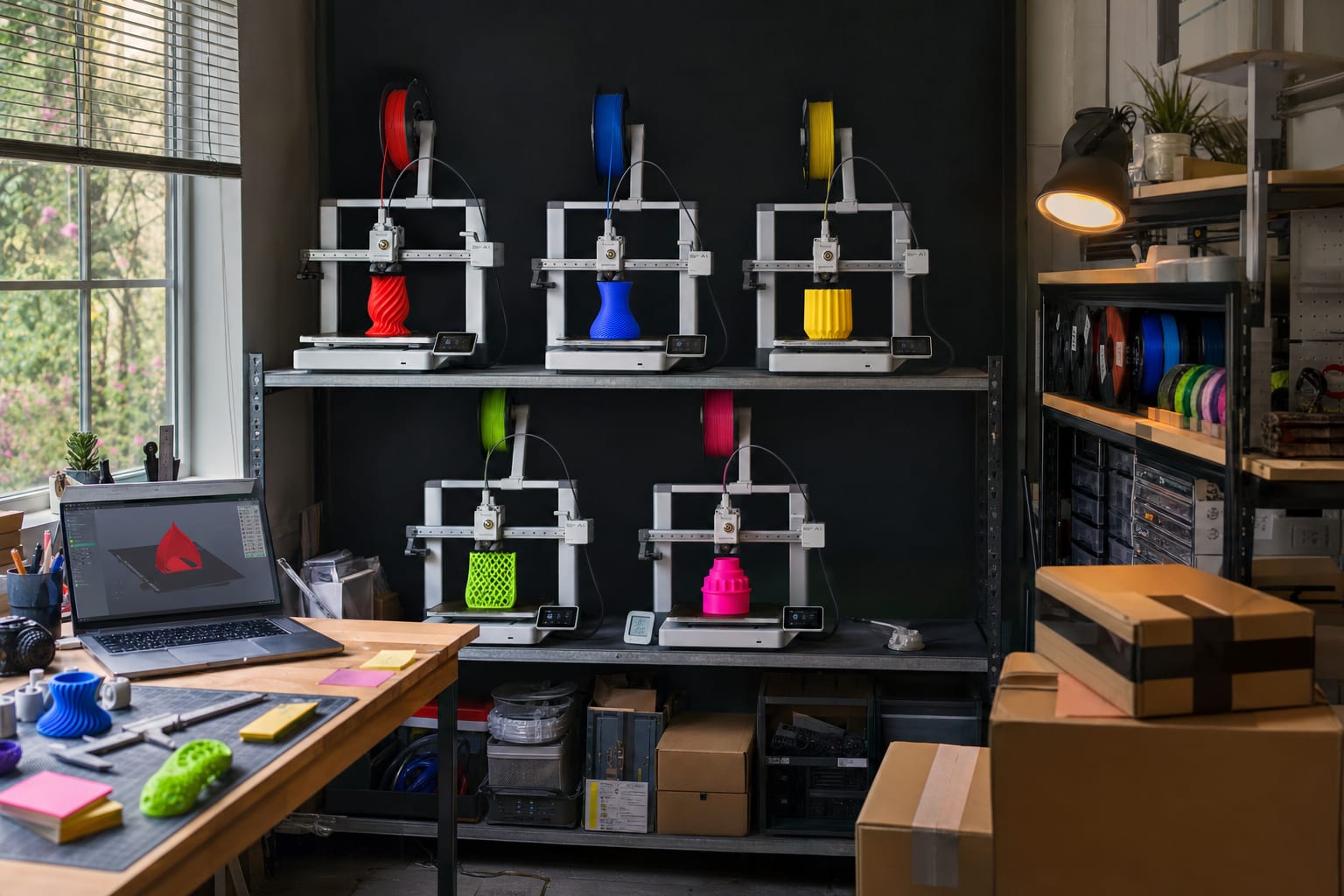
Buying 5 printers when your demand is 50 orders/month doesn't make you scalable — it makes you broke. Print farms only pay back at sustained 150+ orders/month. Here's the timing, the real cost, and the operational discipline that separates a profitable farm from an expensive heap of plastic in your garage.
When You're Actually Ready for Printer #2
Three signals indicating you've outgrown one printer:
- Queue length > 2 days for 3 weeks — orders consistently waiting longer than print time. One bad week is normal; sustained queue is a real signal.
- Turning away custom commissions — you say 'no, can't fit it in this month' to commission requests. Money left on the table.
- Saying yes to bigger orders feels risky — '15 keycap batch order? I'd love to but I can't deliver in time' is opportunity cost
Three signals you're NOT ready:
- Average utilization on printer #1 < 60% — printer idle most of the day. Add a printer = more idle time, not more output.
- Revenue under $1,500/month — you can't pay for printer #2 without eating into your living expenses
- Failure rate above 10% — buying a second printer means doubling your failure absolute count. Fix calibration first.
The Math: When Does a Farm Pay Back?
Bambu A1 Combo: $459. At ~$15 net profit per order (after fees + materials + labor) running 4 orders/day = $60/day = ~$1,800/month per printer. ROI: ~8 days at full utilization.
5-printer farm: $2,295 hardware + $1,200 ramp costs (filament inventory, spares, workspace) = $3,500. At 200 orders/month with $15 net = $3,000/month. ROI: ~5-6 weeks at full utilization.
The risk: utilization isn't full. At 60% utilization (realistic for small farms in months 1-3), ROI stretches to 3-4 months. At 40% (over-ambitious scale-up), 6+ months. Don't scale faster than demand.
Operational Costs Per Printer Per Month
At 80% utilization, one Bambu A1/P1S consumes:
- Filament: 5-8kg/month × $20 = $100-160 — depends on order mix
- Electricity: ~50 kWh × $0.15 = $7-12
- Nozzle replacements: 1 per 800-1500 print-hours, $5 each. Average $5-10/month
- PEI bed wear: replace every 2-3 years, $40. Amortized $1.50/month
- Spare parts overhead: 5-10% of hardware cost annually amortized = $4-8/month
- Total per-printer opex: $120-200/month
Five printers = $600-1,000/month operational costs. Plus your time, platform fees on revenue side.
Setting Up the Physical Workspace
Space
5 Bambu A1s need ~100 sqft of well-ventilated space. Each printer 18×18 inch footprint + 12 inches clearance around for filament feed + nozzle service. Add a 4×8 ft workbench for unloading + packing.
Power
Each A1 draws 150W average. 5 printers = 750W = 6.3A on 120V US. Single 15A circuit handles 5 printers comfortably. Use a power strip with circuit breaker (NOT just surge protector) — overload protection prevents fires.
Ventilation
PLA fumes are low-toxicity but still need ventilation. ABS/ASA fumes are real health concerns. Minimum: open window with fan. Better: dedicated extractor venting outside. Required by fire code in many municipalities for commercial 3D-print operations.
Fire safety
Smoke detector in the room (battery + WiFi-notification preferred). Class C fire extinguisher (electrical fire). 3D printers do catch fire — usually from hotend thermal runaway, blocked cooling fans, or aged power supplies. 1-in-10,000 print-hours fire rate is documented in industry data; 5 printers running 24/7 = ~10 print-hours/day × 5 × 365 = 18,000 hours/year.
Tracking OEE (Overall Equipment Effectiveness)
OEE = Availability × Performance × Quality. Standard manufacturing KPI, applies cleanly to 3D-print farms.
- Availability = (planned hours − downtime) / planned hours. Aim for 90%+.
- Performance = actual print rate / theoretical max. Aim for 90%+. Slow first-layer adjustments, manual interventions drag this down.
- Quality = (good prints) / (total prints attempted). Aim for 95%+. Failures + reprints reduce this.
- OEE target: 60-70% world-class for manual 3D-print operations. Below 50% = workflow problem.
Track in spreadsheet per printer per week:
- Print hours scheduled (e.g. 18 hours/day × 7 days = 126)
- Downtime (jams, failures, restarts) — log every interruption
- Total print starts that week
- Failed prints that week
- Calculate OEE = (126 - downtime) / 126 × (starts - failures) / starts
Workflow That Scales — Batching
Single-print workflow: load filament, print one, unload, repeat. Wasteful at scale because the 5 min/print of human attention compounds.
Batched workflow:
- Sort orders by filament color daily — group all 'green' orders, all 'red', etc.
- Slice plate at a time — fit 3-6 keycaps OR 1-2 cat masks per plate. One print per color per printer.
- Set up all printers in morning batch — load colors, send sliced files. 10 minutes total.
- Mid-day check — quickly remove finished plates, send next batch. 15 minutes.
- Evening pack/ship — accumulate prints, batch-pack and ship at day end. 30-45 min for 20-30 orders.
Total daily operator time at 5-printer farm with batched workflow: 60-90 min/day. Same farm without batching: 4-5 hours/day.
Common Scaling Mistakes
Buying 5 printers at once
Tempting because of bulk discount. Reality: 4 printers sit idle for 2-3 months while you grow into the volume. That's $1,800 of capital tied up earning nothing. Stage purchases by 4-8 weeks each.
Mixing printer models
'I'll get a Bambu A1 + X1C for fancy prints + Prusa for ABS'. Three slicer profiles, three spare-parts kits, three different failure modes. Operational complexity exceeds the benefit unless you genuinely need each machine's capability.
Skipping maintenance
200 hours / nozzle change, 800 hours / lubrication. Skip these and failure rate triples. At 5 printers running daily, you'll be re-doing $50-100 of failed prints/week if you don't maintain.
No queue management software
Tracking 'whose order is on which printer' in your head fails at order #15. Use Notion / Airtable / spreadsheet with order ID, customer, status, ETA. Free, takes 1 hour to set up.
Hiring before you're ready
Hiring helper at $1,500/month means you need $4,000+/month consistent revenue to support it. Hire when revenue is sustained, not 'when I expect it to grow'.
When to Stop Scaling
Above 5-6 printers in a single-operator setup, you hit operational ceiling — you spend more time managing than producing. Three options at this point:
- Hire fulfillment helper — pay $15-20/hr, frees you to focus on design + growth
- Switch to outsourced fulfillment (printing service partners) — lower margin per unit but no capacity constraint
- Specialize toward premium / custom commissions — 5 printers can produce 200 standard orders OR 30 custom commissions. Custom = higher margin per unit, less labor intensive
Most successful 3D-print Etsy shops we've worked with at 42 STUDIO settle at 5-7 printers + 1 part-time helper around $8-12k/month revenue. Above that, switch strategy entirely (multiple shops, wholesale to retailers, or pivot to custom commissions).
Summary
- Don't scale until sustained 2-day queue for 3+ weeks on printer #1
- Stage purchases — one printer, ramp utilization to 70%+, then next
- All same model — operational simplicity beats marginal capability
- Track OEE weekly; aim for 60%+. Below 50% means workflow problem
- Per-printer opex: $120-200/month at 80% utilization
- Fire safety mandatory: smoke detector, Class C extinguisher, ventilation
- Operational ceiling for one person: 5-6 printers + batched workflow
Need commercial-licensed STLs for your scaling shop? Browse our catalog — Etsy-ready commercial tier on all 100+ models. For custom designs to differentiate from competitors, our commission service delivers original IP-owned designs in 7-14 days.


Ready to Start Printing?
Browse our collection of 3D printable models — from flexi toys to cat masks.
Visit Our Store →