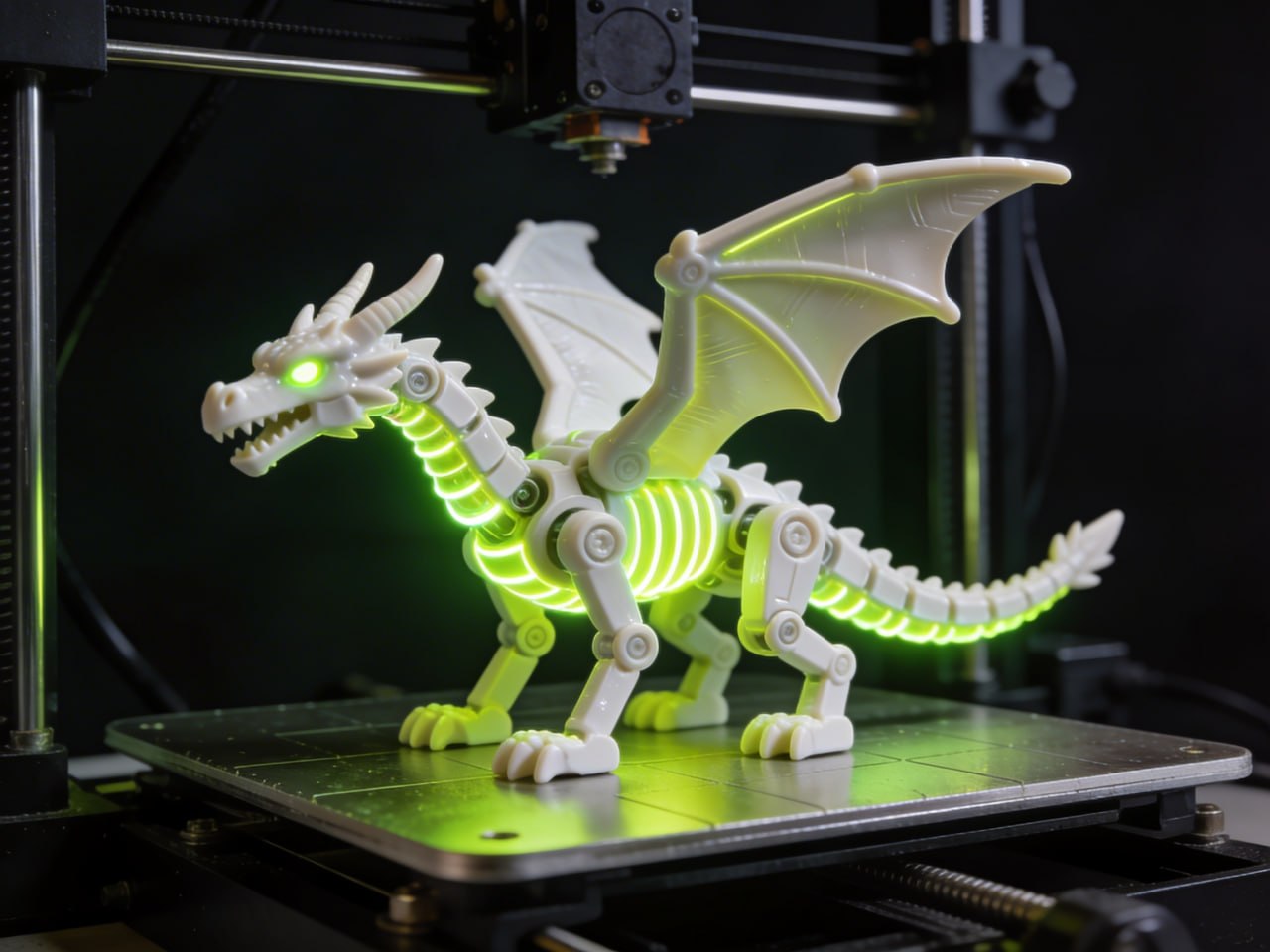
What Are Print-in-Place Toys?
Print-in-place (PIP) models are 3D printed as a single piece with moving parts. No assembly, no glue, no screws — they come off the build plate ready to articulate. The secret is precision engineering: small gaps between parts that bridge during printing but snap free with a gentle twist. It's the closest thing to magic in 3D printing.
How Print-in-Place Joints Work
The core concept is clearance — 0.3mm gaps between moving parts for PLA, 0.4mm for PETG. During printing, the slicer creates thin bridge layers across these gaps. The bridges hold everything in place during printing but are weak enough to break free by hand. Ball joints, hinges, and living hinges all use this principle.
The most common joint types: chain links (each link prints around the previous one), ball-and-socket (a captured ball inside a socket), and pin hinges (a cylinder rotating inside a housing). Our flexi toy collection uses all three.
Perfect Print Settings
Layer height: 0.2mm is the sweet spot. 0.16mm gives finer detail but takes longer and doesn't improve joint function. Avoid 0.28mm+ — clearances become unreliable at thick layers.
Speed: 40-60mm/s. Slower than normal because precision matters for the tiny gaps between parts. Bambu Lab machines can go faster (80-100mm/s) due to better motion systems.
Temperature: 200-210°C for PLA. Too hot = stringing that fuses joints. Too cold = poor layer adhesion and brittle parts.
Cooling: 100% fan speed. Critical for clean bridges across joint gaps.
Supports: NEVER. Print-in-place models are engineered to need zero supports. Adding supports will permanently fuse moving parts.
First Layer Is Everything
An elephant foot (over-squished first layer) kills PIP toys. The first layer expands outward, closing the tiny gaps between joints at the base. Solutions: enable elephant foot compensation in your slicer (0.2mm), raise Z-offset slightly, or reduce first layer flow to 95%. Test with a simple articulated keychain before printing a complex dragon.
Breaking Parts Free
Fresh off the printer, PIP joints are usually stiff. Here's the break-in procedure:
- Gently flex the entire model — PLA has slight give
- Work each joint individually, wiggling back and forth
- For stubborn joints, use needle-nose pliers for leverage
- A hobby knife along joint lines helps if bridges didn't break cleanly
- Once freed, joints will loosen up with use over the first day
Troubleshooting Common Issues
Joints completely fused: Over-extrusion. Calibrate your flow rate — print a single-wall cube and measure wall thickness. It should match your line width (typically 0.4mm).
Joints too loose / floppy: Under-extrusion or too much clearance in the model design. Try increasing flow by 2-3% or lowering print temperature slightly.
Base joints stuck, upper joints fine: Elephant foot. See first layer fixes above.
Breaks when flexing: PLA is semi-brittle. Flex gently — don't force joints past their range. PETG is more forgiving but needs 0.4mm clearance.
Best Materials for PIP
PLA: The default choice. 95% of PIP designs are made for PLA. Stiff enough for clean joints, slight flexibility for break-in. Every color and brand works.
PETG: Tougher and more flexible. Joints survive rougher handling. But needs wider clearances and strings more, which can fuse delicate joints.
TPU: Avoid for PIP. It's flexible, which sounds good, but the flexibility prevents joints from breaking free. Joints print fused and stay fused.
Popular PIP Categories
The 42 STUDIO store features dozens of print-in-place designs across categories:
- Articulated animals: Dragons, cats, frogs, octopuses — the best sellers in 3D printing
- Fidget toys: Spinners, cubes, worm-on-a-string — satisfying desk distractions
- Holiday toys: Christmas ornaments, Halloween decorations, Valentine's keychains
- Character toys: Pop culture figures with moving joints and poseable limbs
PIP toys are the gateway drug of 3D printing — they're fast to print, immediately impressive, and make perfect gifts. Start with a simple flexi animal and work your way up to multi-joint articulated figures.


Ready to Start Printing?
Browse our collection of 3D printable models — from flexi toys to cat masks.
Visit Our Store →