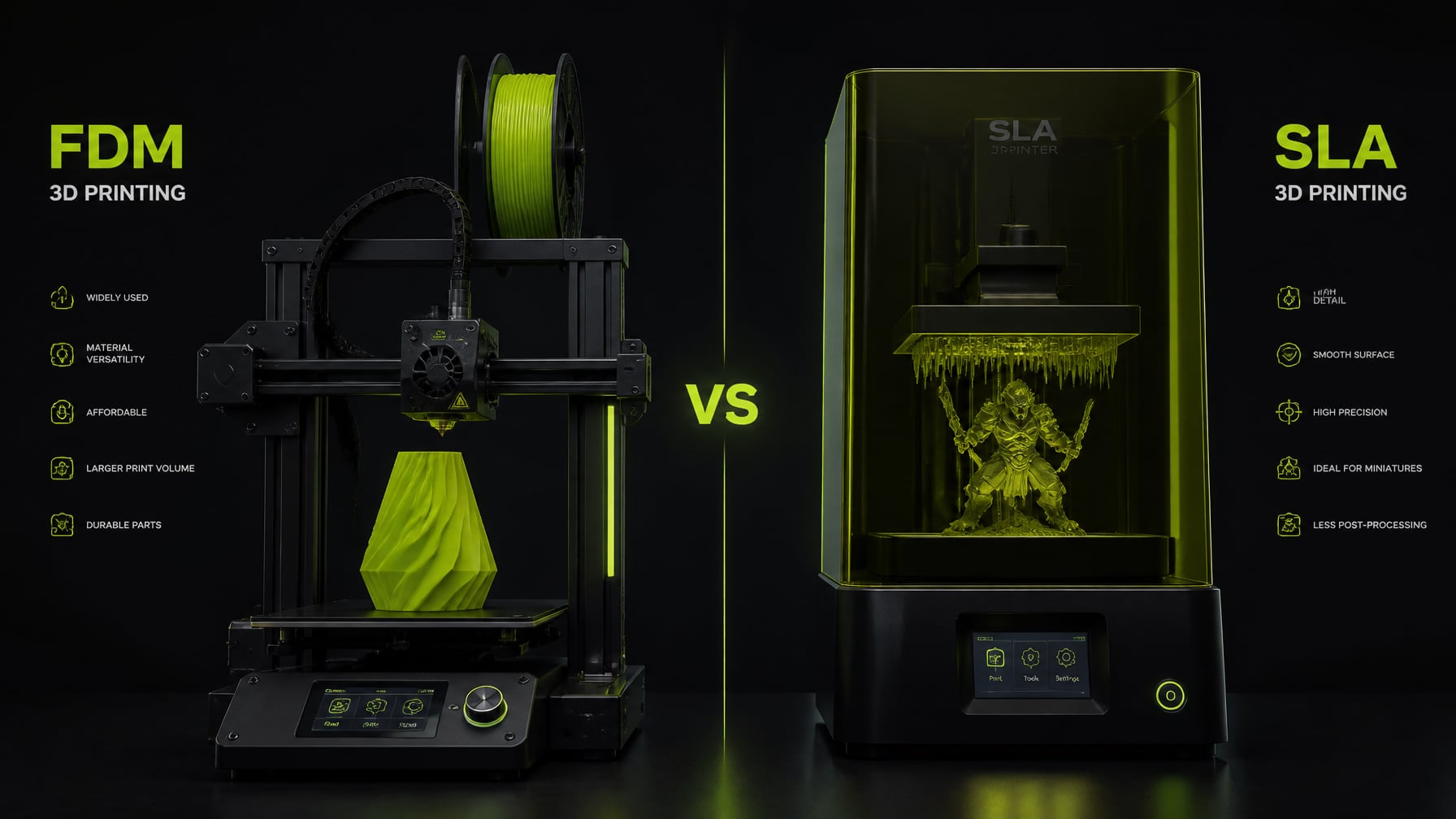
Two Technologies, One Goal
FDM (Fused Deposition Modeling) and resin (SLA/MSLA) are fundamentally different approaches to 3D printing. FDM melts plastic filament and deposits it layer by layer through a nozzle. Resin uses UV light to cure liquid photopolymer in a vat, building objects upside-down on a build plate. Both create 3D objects — but the results, workflow, and costs are dramatically different.
Print Quality: Resin Wins (But It's Complicated)
Resin printers produce stunningly detailed prints. Layer heights of 0.025-0.05mm are standard, making layer lines nearly invisible. Fine details like facial features, text, and textures come out crisp. FDM typically prints at 0.1-0.2mm layers — visible lines are part of the deal.
But here's the thing: for many applications, FDM quality is more than enough. Articulated toys, cosplay props, functional parts — all look great in FDM. Resin shines for miniatures, jewelry, dental models, and anything where sub-millimeter detail matters.
Cost Breakdown
Entry price: Both start around $200. The Elegoo Mars series and Anycubic Photon offer great resin printing under $250. The Bambu Lab A1 Mini and Creality Ender-3 V3 SE cover FDM.
Material costs: PLA filament runs $15-25/kg. Standard resin costs $25-40/liter. But resin prints are typically small and hollow, so per-print costs can be similar.
Hidden costs: Resin requires isopropyl alcohol (IPA) for washing, UV curing stations ($30-80), nitrile gloves, and proper ventilation. FDM? Plug it in and print. Maybe buy a $3 glue stick.
Ease of Use
FDM is dramatically more beginner-friendly. Load filament, slice your model, hit print. Failed print? Peel it off and try again. The worst mess is a spaghetti blob of plastic.
Resin is a chemical process. Uncured resin is toxic — don't touch it without gloves. Prints need washing in IPA, then UV curing. Failed prints mean draining the vat, filtering resin, and cleaning the FEP film. Your workspace smells. Disposal requires curing waste resin in sunlight before trashing it.
Print Size and Speed
FDM printers offer larger build volumes — 220x220x250mm is standard, and large-format printers go up to 400mm+. Print speed has exploded recently: Bambu Lab machines hit 500mm/s, turning 8-hour prints into 2-hour prints.
Resin build volumes are typically smaller — 130x80x160mm for entry-level. Speed depends on layer count, not XY complexity — a full plate of miniatures prints as fast as one. But each layer takes 2-8 seconds, so tall prints are slow regardless.
Strength and Functionality
FDM parts are genuinely strong. PLA handles moderate loads, PETG adds heat resistance and flexibility, and ASA/ABS work for outdoor and automotive applications. Nylon and carbon fiber composites are engineer-grade materials.
Standard resin is brittle. Drop a resin miniature and it shatters. Tough and flexible resins exist but cost more ($40-60/liter) and still can't match FDM engineering materials for functional parts. If you're printing brackets, enclosures, or anything load-bearing — FDM is the answer.
Best Use Cases
Choose FDM for:
- Articulated and flexi toys (browse our collection)
- Cosplay props and helmets
- Functional parts, enclosures, brackets
- Large prints (vases, busts, furniture parts)
- Prototyping and iteration
- Anything your kids will touch
Choose Resin for:
- Tabletop miniatures (D&D, Warhammer)
- Jewelry and dental models
- Highly detailed figurines
- Small production runs of precise parts
The Verdict
If you're buying your first printer: get FDM. It's cheaper to run, easier to use, more versatile, and produces strong parts. Once you've got the basics down and specifically need ultra-fine detail, add a resin printer to your setup. Most serious makers end up owning both — FDM for daily use, resin for special projects.


Ready to Start Printing?
Browse our collection of 3D printable models — from flexi toys to cat masks.
Visit Our Store →