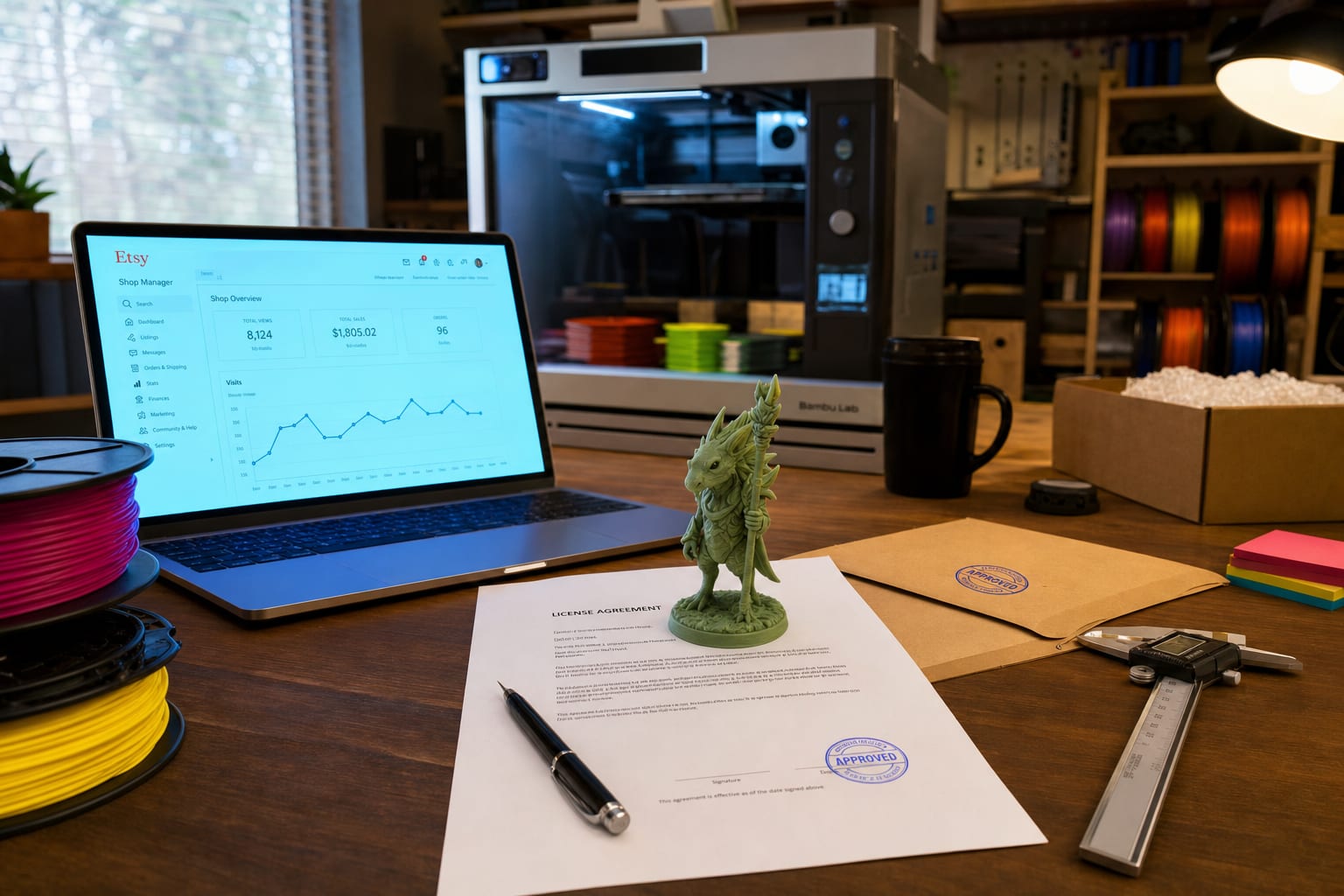
You found a great STL. The download page says 'commercial use allowed'. Are you safe to print 100 of them and list on Etsy? Maybe — and that maybe has gotten thousands of shops banned. Commercial licensing in 3D printing is messier than it looks. Here's how it actually works, what triggers DMCAs, and how 42 STUDIO's subscription model gives you commercial rights across the entire catalog.
Three Layers of Rights You Need
When you 'commercially license' an STL, three legal layers stack:
- Layer 1 — STL file copyright. The designer owns the digital file. The license tells you what you can do with it (print, modify, redistribute the file, sell prints).
- Layer 2 — Character IP (if applicable). If the model represents Mickey Mouse, Iron Man, Pikachu — the character itself is trademarked by Disney/Marvel/Pokemon Company. STL license doesn't grant rights to the underlying character.
- Layer 3 — Original/derivative art. If the STL is 'inspired by' but legally distinct from a copyrighted character ('cute mouse with red shorts' vs Mickey Mouse), you're in a grey zone. Some shops live there for years; some get DMCA'd on day one.
Most sellers think only about Layer 1. That's why Pokemon-cosplay shops on Etsy get hit by DMCAs even when their STL provider explicitly said 'commercial use allowed' — STL provider can't grant rights they don't own.
Common License Tiers You'll Encounter
STL marketplaces don't use standard names. Same word means different things on different sites.
Creative Commons (free models)
- CC0 (Public Domain) — do anything, no attribution needed. Safest for resellers but rare for quality models.
- CC-BY — commercial use OK, must credit the original designer in listings.
- CC-BY-SA — commercial OK, but your modifications must also be CC-BY-SA. Bad for resellers (forces you to release your own designs free).
- CC-BY-NC — NON-COMMERCIAL. Cannot sell prints. Most Thingiverse models. Most-violated license on Etsy.
- CC-BY-ND — no derivatives. Cannot modify; selling prints of unmodified file may be OK depending on jurisdiction.
Paid marketplace licenses
- Cults3D — Single Use — print one for yourself. No selling.
- Cults3D — Royalty-Free Commercial — sell unlimited prints. Usually 5-10x the personal-use price.
- MyMiniFactory — Commercial Tier — sell prints with attribution.
- MakerWorld — Boost — internal Bambu reward system, not a commercial-use grant on its own.
- CGTrader Royalty-Free — usually grants commercial use; check per-model terms.
- 42 STUDIO Commercial Tier — print and sell unlimited units; see /licenses for full terms
Custom commission licenses
When you pay a designer to create a model for you, license terms are whatever you negotiate. Typical structures:
- Buy-out (full IP transfer) — you own the STL outright, designer can't reuse. Most expensive (~2-3x base design fee).
- Exclusive commercial license — only you can sell prints; designer keeps copyright. Mid-range.
- Non-exclusive commercial license — you can sell, designer can also license to others. Cheapest tier of paid commercial.
How DMCA Takedowns Actually Work on Etsy
Two paths lead to takedowns:
Path 1 — Character IP holder reports
Disney, Pokemon Company, Nintendo, Hasbro have full-time legal teams scanning Etsy/Amazon for unlicensed character merch. If your listing has 'Pikachu', 'Iron Man', 'Baby Yoda' in title/tags — odds of getting hit are HIGH within 90 days.
What gets DMCA'd:
- Explicit character names in title or tags
- Logos / trademarked imagery in product photos
- Buyer reviews mentioning the character (Etsy searches these too)
Path 2 — STL designer reports
Less common but happens — designers find their CC-NC-licensed STLs being sold and report. Usually starts with a warning DM ('please remove or upgrade to commercial license') before DMCA escalation.
What a DMCA looks like on your end
- First time — email from Etsy. 'Listing X removed for IP violation.' Warning point on account.
- Second time — 30-day shop suspension. All listings paused, revenue frozen pending review.
- Third time — permanent shop ban. Funds in account may be held for chargeback period.
- Counter-notice rarely works for sellers — designed for fair-use cases (parody, commentary), not commercial reselling.
How to Verify a License Before Buying or Listing
- Read the actual license text, not the marketing copy on the product page. Marketplaces sometimes say 'commercial use!' on the listing card and then bury terms in fine print.
- Check for explicit commercial-use language — 'May be sold' or 'commercial reproduction permitted' or 'royalty-free commercial license'. Vague phrasing = ambiguous rights.
- Verify designer is the actual creator — re-uploads of others' work happen. Some marketplaces let anyone upload; verify the original source. Reverse-image-search the model preview.
- Check for character/IP layer — even with full STL commercial license, is the model itself a likeness of a copyrighted character? If yes, you need TWO licenses.
- Save the license text — screenshot, PDF, link to archived version. If license terms change later, your purchase still operates under the version you bought.
- Keep purchase receipts — Etsy/CGTrader/etc. order history. If a DMCA arrives, your proof of license is what gets the takedown reversed.
42 STUDIO License: Tied to Your Subscription
Unlike per-product license models where you buy a 'commercial tier' upgrade on each STL, 42 STUDIO licensing is tied to your active subscription plan. One subscription unlocks commercial rights across the entire catalog as long as your plan is active.
- Starter — $5.90/mo ($3.54/mo annual). 5 downloads/month. Personal use only — print for yourself, friends, family. No selling.
- Builder — $11.60/mo ($7.00/mo annual). 20 downloads/month. Full commercial license — sell unlimited physical prints on Etsy / Amazon Handmade / Shopify / your own shop / conventions / local markets. STL file itself cannot be redistributed.
- Infinity (All-Shop Pass) — $25/mo ($15/mo annual). Unlimited downloads, all categories. Full commercial license identical to Builder, plus weekly new releases auto-added to your library.
- Custom commission via /business — separate from subscriptions. Pay once, receive a unique STL designed for you with full IP transfer — you own it outright, the designer cannot resell. For brand/exclusive use.
Two key practical points:
- Commercial rights ACTIVE only while subscription is. Cancel Builder → your right to sell prints stops on the next billing cycle. Existing inventory you already produced can be sold, but new prints from the same STLs need an active commercial plan.
- Each active subscriber gets a personalized commercial certificate (PDF, your name + dates) — bookmark in case of DMCA disputes or buyer-platform license questions. Available in your account at /license.
Subscription-tied commercial license is the right model for ongoing resellers — predictable cost, immediate access to new releases, no need to upgrade-purchase per product. If you need permanent ownership of a SINGLE design (logo, branded item, exclusive cosplay piece), a custom commission gives you full IP transfer separately.
When You Should Commission Instead of Buy Off-the-Shelf
Three scenarios where custom commission beats licensed STL:
- You're building a brand. Generic commercially-licensed STLs mean your competitor sells the same physical item. Custom design = visual moat.
- You want full IP ownership. Only commission gives you full transferable rights (and the ability to license OTHERS to use it later).
- You're targeting niche/local market the existing catalog doesn't cover — military unit insignia, regional sports teams, corporate gifts. Catalog STLs won't have these.
Typical commission cost: $200-800 for a single design (keycap to figure scale). Pays back in 15-50 sales. Book a commission → designer brief → STL delivered in 7-14 days, you own it forever.
Common License Mistakes That Kill Shops
- 'Free for personal use' assumed to mean commercial — read carefully, almost never is
- Thingiverse models without verifying license — most are CC-NC, can't be sold
- Generic 'commercial license OK' on cheap STL marketplaces — sometimes uploaded by people who don't own the model. License can be revoked if original creator complains.
- Selling licensed-character merch with 'commercial' STL — STL provider can't grant character IP rights
- Modifying a non-commercial STL and assuming you own the result — derivative-work rules usually apply
- Not saving license text / receipts — when DMCA arrives, can't prove you bought legitimately
Summary
- STL commercial license ≠ unlimited commercial use. Read exact terms.
- Free STLs from Thingiverse are usually NON-commercial. Don't list them.
- Character IP is separate from STL license. Pikachu STL with 'commercial' rights still needs Pokemon Company permission.
- Three DMCA strikes = permanent Etsy ban. Verify before listing.
- 42 STUDIO subscription model: Builder ($11.60/mo) or Infinity ($25/mo) unlocks commercial rights across the entire catalog — no per-model upgrades needed.
- Commercial rights are ACTIVE only while the subscription is paid. Cancel = right to print-for-sale stops on next billing cycle.
- For full IP ownership of a unique design: custom commission via /business is separate from subscriptions.
- Save your subscription certificate (auto-issued at /license for active subscribers) — it's your DMCA defense.
Subscribe to Builder or Infinity for commercial rights across our entire catalog, or commission a custom design for full IP ownership of a unique piece.


Ready to Start Printing?
Browse our collection of 3D printable models — from flexi toys to cat masks.
Visit Our Store →